If you’re house-hunting around Upper Thomson, Bishan or Ang Mo Kio with young children, one question shapes everything: which primary schools are actually within reach from here? This part of Singapore is unusually dense with sought-after schools — but “nearby” and “gettable” are not the same thing. Below is a practical guide to the main primary schools in the area, with the actual 2026 P1 registration outcomes for each, so you can see where a ballot is likely and where there’s genuinely room.
First: How the 1km Rule Really Works
Every year, MOE runs P1 registration in phases. Most families without sibling, alumni or volunteer links register in Phase 2C — the open phase. When a school gets more applicants than places in Phase 2B or 2C, places are decided by ballot, and home-to-school distance sets the priority order:
- Singapore Citizens living within 1km — first priority
- Singapore Citizens living between 1km and 2km — next
- Singapore Citizens living beyond 2km — after that
- Permanent Residents follow, in the same distance order
At a popular school, places often run out before the queue reaches families beyond 1km. So the distance band isn’t a tie-breaker — it’s frequently the entry ticket. And note the nuance: being inside 1km puts you in the priority band, but if that band itself is oversubscribed, a ballot still applies within it.
The Schools Within 1km–2km of Upper Thomson
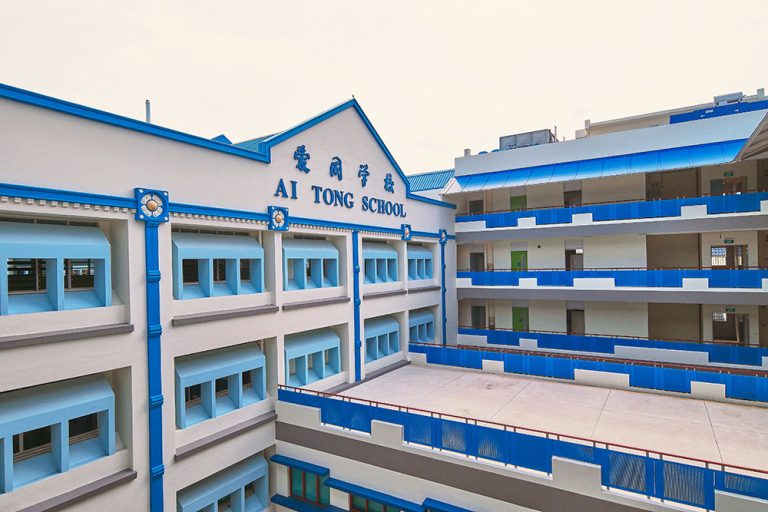
Ai Tong School — Bishan (the one everyone asks about)
A government-aided SAP primary school at 100 Bright Hill Drive, co-ed, affiliated with the Singapore Hokkien Huay Kuan and known for its bilingual English–Chinese programme. It’s also the most contested school in the immediate area.
2026 outcome: Phase 2C drew 76 applicants for 40 places (1.9×), with balloting conducted for Singapore Citizens within 1km. Phase 2B was tighter still at 51 applicants for 20 places (2.55×), also balloted within 1km — the second-most oversubscribed 2B nationally. Even Phase 2A balloted (160 for 119). Total intake: 300.
What it means: from outside 1km, the open phases were effectively closed. From inside 1km, you’re in the right band — but you’re balloting against roughly two applicants per place.
Catholic High School (Primary) — Bishan
A SAP boys’ school, also with a strong bilingual tradition and a well-known secondary affiliation.
2026 outcome: Phase 2C saw 64 applicants for 41 places (1.56×), balloted within 1km. Phase 2B: 35 for 20 (1.75×), also balloted within 1km. Intake: 240. Slightly less pressured than Ai Tong, but still a within-1km ballot.
CHIJ St. Nicholas Girls’ School (Primary) — Ang Mo Kio
A SAP girls’ school with a strong academic reputation and a secondary affiliation on the same campus.
2026 outcome: Phase 2C had 78 applicants for 48 places (1.63×), balloted within 1km. Phase 2B was the pinch point at 49 for 24 (2.04×). Notably, Phase 2A was not oversubscribed (93 applicants for 105 places). Intake: 210.
Kuo Chuan Presbyterian Primary — Bishan
A co-ed school, often the strong “second choice” for Bishan families, with its own secondary affiliation.
2026 outcome: Phase 2C drew 82 applicants for 48 places (1.71×), balloted within 1km; Phase 2B 37 for 24 (1.54×). Intake: 240.
Anderson Primary — Ang Mo Kio
2026 outcome: Phase 2C had 101 applicants for 77 places (1.31×) — but here’s the important difference: the ballot was held for citizens between 1km and 2km, meaning within-1km applicants were all accommodated first. Intake: 210.
The Less-Contested Options (Where There Was Room)
Not every school in the area is a scramble. Several nearby schools were comfortably under-subscribed in Phase 2C 2026 — worth knowing if you want a realistic backup, or simply a shorter, calmer commute:
| School | Area | Phase 2C 2026 | Ballot? |
|---|---|---|---|
| Marymount Convent School (girls) | Toa Payoh | 27 applicants / 210 places | No |
| Ang Mo Kio Primary | Ang Mo Kio | 27 applicants / 137 places | No |
| Mayflower Primary | Ang Mo Kio | 28 applicants / 101 places | No |
| Teck Ghee Primary | Ang Mo Kio | 90 applicants / 124 places | No (2C) |
| Jing Shan Primary | Ang Mo Kio | 57 applicants / 60 places | No (2C) |
Teck Ghee and Jing Shan did ballot at the smaller Phase 2C Supplementary stage. Source: MOE 2026 P1 Registration Exercise.
At a Glance: 2026 Phase 2C Competition
| School | Type | 2C applicants / places | Ratio | Ballot band |
|---|---|---|---|---|
| Ai Tong School | SAP, co-ed | 76 / 40 | 1.90× | Within 1km |
| Kuo Chuan Presbyterian Pri | Co-ed | 82 / 48 | 1.71× | Within 1km |
| CHIJ St. Nicholas Girls’ (Pri) | SAP, girls | 78 / 48 | 1.63× | Within 1km |
| Catholic High (Pri) | SAP, boys | 64 / 41 | 1.56× | Within 1km |
| Anderson Primary | Co-ed | 101 / 77 | 1.31× | 1km–2km |
| Ang Mo Kio Primary | Co-ed | 27 / 137 | 0.20× | No ballot |
| Marymount Convent | Girls | 27 / 210 | 0.13× | No ballot |
How to Read This as a Home Buyer
A few practical takeaways from the 2026 numbers:
- Within 1km is doing the heavy lifting. Four of the area’s most popular schools balloted specifically within the 1km band in Phase 2C 2026 — outside it, the open phases were effectively out of reach.
- Priority is not a promise. At Ai Tong, 76 within-1km applicants competed for 40 places. Living close improves your odds substantially; it doesn’t guarantee a seat.
- Have a genuine second choice. The area has several under-subscribed schools with real capacity — a sensible backup rather than a consolation prize.
- Odds move every year. Peak national competition actually eased in 2026 (the most oversubscribed school fell from 5.66× to 3.98×), while intake is being gradually trimmed. Always check the current year.
Why This Corner of Singapore Draws Families
Put together, the Upper Thomson–Bishan–Ang Mo Kio belt offers something rare: several SAP and affiliated schools clustered within a couple of kilometres, feeding into strong secondary options and junior colleges nearby, all wrapped in an established, green, MRT-connected neighbourhood. That’s the underlying reason homes here hold long-term appeal for families — and why the 1km question comes up in almost every viewing.
If you’re weighing a home in this catchment, our guide to the Ai Tong 1km priority goes deeper on how the phases work, and Thomson Reserve sits on Bright Hill Drive within that 1km radius.
Frequently Asked Questions
Which primary schools are within 1km of Upper Thomson?
Ai Tong School on Bright Hill Drive is the primary school within the 1km band for much of the Upper Thomson stretch. Catholic High (Primary), CHIJ St. Nicholas Girls’ (Primary) and Ang Mo Kio Primary generally fall in the wider 1km–2km area. Distances depend on your exact address — confirm via the MOE School Finder or OneMap.
Which school near Bishan is hardest to get into?
Of the area schools, Ai Tong was the most contested in 2026: Phase 2C drew 76 applicants for 40 places (1.9×) with a ballot within 1km, and Phase 2B was tighter at 2.55×.
Are there primary schools nearby that don’t ballot?
Yes. In Phase 2C 2026, Marymount Convent, Ang Mo Kio Primary and Mayflower Primary all had more places than applicants and did not ballot, making them realistic options with genuine capacity.
Does living within 1km guarantee a place?
No. It places your child in the top distance-priority band, but if that band is oversubscribed a ballot is still held within it — as happened at Ai Tong, Catholic High, CHIJ St. Nicholas Girls’ and Kuo Chuan Presbyterian in 2026.
Figures are from the 2026 Primary 1 Registration Exercise as published by MOE (Phase 2C results published 5 August 2026; Phase 2C Supplementary final figures 22 August 2026; registration outcomes 27 August 2026) and are provided for general reference only. Distance bands are measured by MOE using OneMap road-network distance from the registered address — verify your own address before relying on it. Registration outcomes, vacancies and intake change every year and are not indicative of future results. This article is general information and not advice; please confirm current figures with MOE.